Why current is dangerous for a patient: macroshock and microshock
Explain what makes electric current dangerous, tell macroshock from microshock, and understand why a current too small to feel can kill a patient with a conductive path to the heart - so that every limit in the rest of the course makes sense.
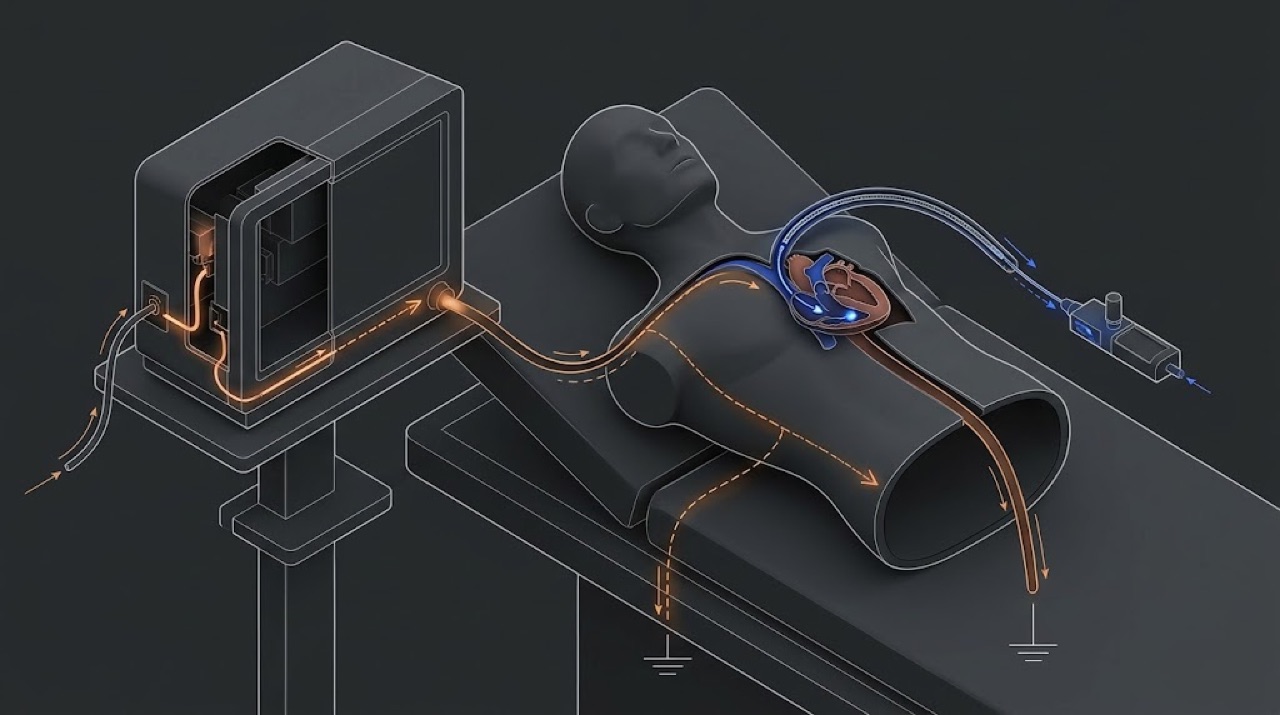
It is the current, not the voltage
Engineers often say 'it is only 24 volts' or 'it is mains, be careful'. Both statements talk about voltage, but tissue is damaged by current flowing through it. Voltage only matters because it pushes current through whatever resistance is in the way. The same 230 V can give you an unpleasant jolt through dry boots and kill you through a wet floor.
The body is a poor conductor on the outside and a fair conductor on the inside. Dry, intact skin has a high resistance; the inside of the body - blood, muscle, body fluids - is a salty electrolyte with a resistance of a few hundred ohms between hands and feet. Once the skin is bypassed, wetted, broken or covered with conductive gel, the resistance of the circuit collapses and the current at the same voltage rises many times.
Three more things decide what a given current does. The path: current from hand to hand or hand to foot crosses the chest, current from finger to finger on one hand mostly does not. The duration: the longer the current flows, the lower the level that causes fibrillation, and a current lasting through a full cardiac cycle is much more dangerous than a short pulse. The frequency: the 50 or 60 Hz of the mains is close to the worst possible frequency for the heart and for muscles. Much higher frequencies, like those used in electrosurgery, mainly heat tissue instead of stimulating it.
Keep this picture in mind: current, path, duration, frequency. Every protective measure in a medical device is about keeping one of these small or harmless.
What current does to the body
The effects of mains-frequency current through the body have been studied for decades and are summarised in the IEC 60479 series. The thresholds are statistical - they vary with body size, path, health and the individual - so read the figures below as orders of magnitude, not as safe or unsafe lines.
For current flowing hand to hand or hand to foot through intact skin, the classic ladder looks like this:
- Around 1 mA: the threshold of perception - a tingle you notice.
- Several mA: painful; muscles start to react involuntarily.
- Roughly 10-20 mA: the 'let-go' threshold - flexor muscles of the hand contract and the person cannot release the conductor. The let-go current is lowest around mains frequency.
- Tens of mA sustained: breathing muscles can be affected; the person may not be able to breathe while the current flows.
- Roughly 50-100 mA and above for about a second: risk of ventricular fibrillation - the heart muscle stops pumping in a coordinated way. Without defibrillation, this is fatal within minutes.
- Amperes: burns, tissue destruction, cardiac arrest.
Macroshock: current through the skin
Macroshock is the situation everybody imagines: a person touches a live part, current enters through the skin at one point and leaves through the skin at another, usually hand to hand or hand to feet. The current spreads through the whole volume of the chest, and only a small fraction of it actually passes through the heart muscle. That is why the fibrillation threshold for macroshock is in the tens to hundreds of milliamps.
Macroshock is a risk to everybody in the room: the patient, the nurse, the cleaner and you. It happens when the basic insulation of a device fails and its protective earth does not do its job, when a damaged cord exposes a conductor, when liquid enters an enclosure, or when an engineer works on an open device with mains connected.
The defences against macroshock are the ones you already know from general electrical work: insulation between mains and anything a person can touch, a protective earth connection that carries fault current away and trips the protection, double insulation where there is no earth, and correct installation with residual current devices or isolated supplies where local rules require them.
Microshock: current straight to the heart
Now change one thing. The patient has a conductive path that ends inside or on the heart: a temporary pacing wire, an intracardiac catheter, a central venous line filled with saline, a pressure transducer line in the right atrium, an electrode used during cardiac surgery. Current that enters through such a path is not spread over the chest. It is concentrated at a small area of myocardium, and the current density there is very high.
In this situation the fibrillation threshold drops by roughly three orders of magnitude: from tens of milliamps to tens or low hundreds of microamps. This is microshock. The commonly taught safety limit for current that may reach the heart directly is 10 µA - well below anything a person can feel, and below what most people think of as 'electricity' at all.
Microshock has three properties that make it treacherous. The patient cannot feel it, so there is no warning. The patient is often sedated, anaesthetised or unconscious, so there is no reaction. And the source is not a broken device in the dramatic sense - it is the ordinary, small leakage current that every mains-powered device produces, or a few hundred millivolts of difference between two earth points in the room, applied through a path that should never carry current.
This is why the strictest requirements in IEC 60601-1 are reserved for applied parts intended for direct cardiac application - type CF, which you will study in lesson 2. Their allowed patient leakage is an order of magnitude below that of parts that touch only the skin.
Why the hospital makes it worse
A patient in a hospital bed is far more vulnerable than a healthy person at home. Skin resistance is deliberately reduced: ECG and ESU electrodes are gelled to make good contact, skin is wet with fluids or disinfectant, and needles and catheters bypass the skin completely. The patient may be lying on a metal-framed bed connected to several devices at once - a monitor, an infusion pump, a ventilator, a warming blanket - each with its own leakage and its own connection to earth.
When several devices touch one patient, their leakage currents can add up, and the patient can become the conductor between two points at slightly different potentials. A fault in one device can push current through an applied part of another. A nurse who touches a faulty device with one hand and the patient's catheter with the other can become the bridge. Multiple socket outlets, extension leads without earth, and devices brought in from home or another ward add uncontrolled paths.
That is why rooms used for cardiac procedures have equipotential bonding and often isolated power supplies, and why the standard treats a combination of devices around a patient as a medical electrical system with its own requirements. Local installation rules differ between countries; your job is to know that these protections exist and not to defeat them.
Where leakage current comes from
Leakage current is not a fault in itself. Every mains-powered device has capacitance between its live conductors and everything around them: the windings of the transformer to its core and screen, the mains filter capacitors connected from line and neutral to earth, the power cord conductors to each other, the circuit board tracks to the chassis. At 50 or 60 Hz, those capacitances pass a small current. Insulation is also never perfect, and dirt, moisture and ageing let more current through.
In a correctly working Class I device, almost all of this current flows harmlessly down the protective earth conductor. The trouble starts in a single fault condition: if the protective earth is broken, the same current looks for another way to earth - through the enclosure into the person touching it, or through the applied part into the patient. If mains voltage appears on a patient from another device, the isolation of the applied part is all that stands between that voltage and the patient's heart.
Medical device standards are therefore built around the idea that one fault must not create a hazard. The device must be safe in normal condition and remain safe when any single protective means fails. The leakage tests you will perform measure exactly how much current would reach a person or a patient in those conditions.
What this means for the service engineer
Almost everything you do inside a device can change its leakage or its protection: replacing a power supply, refitting a mains filter, re-routing a cable near the mains part, replacing an earth screw or a lost star washer, changing a probe or a patient cable for a cheaper one, adding a connection to 'cure' interference. The device left the factory with its protection tested. After your repair, you are the last person who can confirm it is still there.
Two rules follow from this lesson. First, never measure or troubleshoot leakage on a device that is connected to a patient - take it out of clinical use first. Second, treat any report of a tingle, a shock or a 'buzzing' enclosure as a safety incident, not a nuisance: if a nurse can feel it, a patient with a central line may already be at risk.
- Work on mains-powered equipment only with the mains disconnected unless the procedure requires power; if it does, use an isolating transformer or follow your organisation's live-work rules.
- Discharge capacitors before touching high-voltage sections; respect the manufacturer's warnings.
- Do not defeat protective earth with adaptors or by cutting an earth pin to make a plug fit.
- After any repair that touches the mains part, the protective earth, the enclosure or an applied part, perform an electrical safety test before returning the device to service.
The tingle at the bedside
A nurse in an intensive care unit reports a slight tingle when she touches the metal rail of a bed and the housing of an infusion pump at the same time. The ward has already called it 'static' twice. The engineer takes the bed space out of use and finds the pump, a monitor and a warming unit all plugged into an extension strip lying on the floor. The strip's earth conductor is broken inside the plug. Three Class I devices had no protective earth at all; their normal leakage was flowing to earth through whoever touched them. The patient in that bed had a central venous line. The strip is removed, the devices are tested and pass, and the ward bans uncontrolled extension strips.
A tingle that staff can feel means a current far above what a patient with a conductive path to the heart can tolerate. Treat it as an incident, take the bed space out of use, and look for the lost earth before you look for a broken device.
On-site checklist
- Remember: current through the heart kills, voltage only drives it; path, duration and mains frequency make it worse.
- Macroshock: through the skin, tens of milliamps and above, a risk to everybody in the room.
- Microshock: through a conductive path to the heart, tens of microamps, felt by nobody, prevented only by design and testing.
- Never measure or troubleshoot leakage on a device connected to a patient.
- Treat any report of a tingle or shock from equipment as a safety incident and take the equipment out of use.
- Check for missing earths in the installation: extension strips, adaptors, damaged plugs and outlets.
- After any repair touching mains, earth, enclosure or applied parts, run an electrical safety test before return to service.