What happens to the patient under anaesthesia
Understand what the anaesthesia workstation does for a patient during induction, maintenance and low-flow anaesthesia, and why every design decision in the machine starts from one rule: the patient must always receive oxygen.
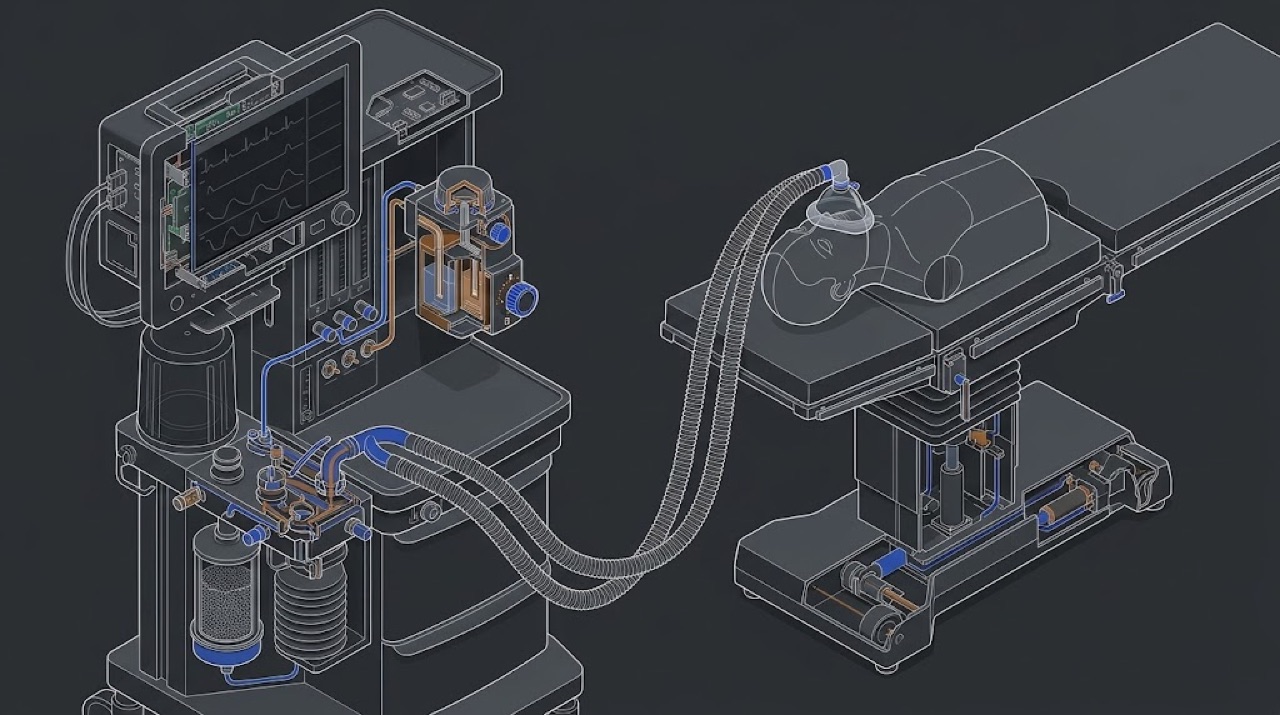
A patient who cannot protect himself
General anaesthesia is a controlled, reversible loss of consciousness. The drugs that switch off awareness and pain also switch off, partly or completely, the reflexes that keep a person alive on his own: the drive to breathe, the muscle tone that keeps the airway open, the cough and swallow that protect the lungs. Very often the anaesthetist also gives a muscle relaxant so that the surgeon can work, and then the patient cannot breathe at all without help.
For the length of the operation, the workstation and the person standing next to it take over jobs the body normally does without thinking. The machine supplies the gas the patient breathes, sets its oxygen content, adds the anaesthetic vapour, moves the gas in and out of the lungs when the patient cannot, removes carbon dioxide and measures all of it. If any of these jobs fails quietly, the patient cannot complain. He cannot tell anyone that he is short of oxygen or that he is waking up.
This is why an anaesthesia machine is treated as life support, and why everything in this course, from the wall outlet to the final report, is built around that fact. You are not maintaining a piece of furniture with a screen. You are maintaining the one thing standing between an unconscious person and hypoxia.
Induction, maintenance, emergence
An anaesthetic has three phases, and each one asks something different from the machine. You do not need to know the drugs and doses. You do need to know which part of the machine is working hardest at each moment, because complaints from theatre are usually tied to one phase.
Before induction the anaesthetist usually breathes the patient on high-flow oxygen through a face mask, to fill the lungs with oxygen and buy time for securing the airway. The workstation must deliver a high fresh gas flow of oxygen, the reservoir bag and mask circuit must be tight, and the oxygen flush must work. A leak at this stage is felt immediately: the bag does not fill, the mask does not seal.
During maintenance the patient is usually intubated or has a laryngeal mask, the ventilator is breathing for him or supporting his own breaths, and the vaporiser adds a steady concentration of volatile agent. The machine now runs for hours with little attention. Accuracy matters more than speed: the delivered oxygen, the agent concentration, the tidal volume and the alarms must be right, and the CO2 absorber must keep removing carbon dioxide.
At emergence the vaporiser is turned off, fresh gas flow is increased to wash the agent out, and the patient goes back to breathing on his own. The ventilator is switched to manual or spontaneous mode, the APL valve and the bag are used again, and the scavenging system carries a burst of exhaled agent away from the room. Problems with the APL valve, the bag or the scavenging interface often show up here.
- Induction: high oxygen flow, mask and bag circuit, oxygen flush, leak-tight manual circuit.
- Maintenance: ventilator accuracy, vaporiser output, oxygen and agent monitoring, absorber, alarms.
- Emergence: manual and spontaneous breathing, APL valve, bag, scavenging.
Why the gas goes round in a circle
An ICU ventilator usually throws exhaled gas away. An anaesthesia workstation normally does not. It uses a circle breathing system: the patient breathes out through one-way valves into a canister of CO2 absorbent, the cleaned gas is mixed with a small amount of fresh gas, and the patient breathes it in again. The anaesthetic agent the patient did not take up is used again instead of being blown into the room.
This saves expensive agent, keeps the gas warm and moist, and reduces pollution. It also means the gas the patient breathes is not exactly the gas you set on the flowmeters. What the patient inhales is a mix of fresh gas and rebreathed gas, and the difference grows as the fresh gas flow falls. This is the reason the workstation must measure inspired oxygen, inspired agent and carbon dioxide in the circuit itself, not just trust the settings.
Two parts of the circle deserve your attention from day one. The one-way valves must open and close properly, otherwise exhaled gas goes back to the patient without passing the absorber and inspired CO2 rises. And the absorbent must still be working: when it is exhausted, CO2 also comes back. The gas monitor shows both as inspired CO2 above zero.
Low-flow anaesthesia and what it demands from the machine
Many anaesthetists run the maintenance phase with a very low fresh gas flow. Textbooks commonly call fresh gas flows of about 1 litre per minute or less 'low flow', and flows around 0.5 litre per minute 'minimal flow'. At these flows almost everything the patient breathes is rebreathed gas, and the machine only tops up what the patient consumes and what leaks out.
Low-flow anaesthesia is good for the patient, the budget and the environment, but it is unforgiving to the machine. Three things follow from it, and you will meet all three in service calls.
First, leaks matter far more. At a high fresh gas flow a small leak is covered by the excess gas. At a minimal flow, a leak of a few hundred millilitres per minute can be a large part of everything going in, the bag or bellows slowly empties, and the ventilator reports low volumes. A circuit that 'worked fine yesterday' may fail as soon as the anaesthetist turns the flow down.
Second, the oxygen fraction in the circle can drift down. The patient keeps taking oxygen out, while the nitrous oxide or air in the circle is taken up much more slowly. The oxygen monitor and its low-oxygen alarm are the last line of protection here, so a weak oxygen cell or a badly calibrated gas module is a safety problem, not a nuisance.
Third, the absorbent works harder, and dried-out absorbent can react with some volatile agents. This is a clinical and consumable issue more than an engineering one, but you should know that absorbent left in a machine with gas flowing through it for days or weeks can dry out. Tell the department if you find a machine left with fresh gas running after a list.
The one rule: the patient always gets oxygen
A modern workstation is crowded with features, but its safety design follows one idea: whatever else fails, the patient must still get oxygen, and the machine must never deliver a mixture with too little of it. You will meet this idea again and again in the following lessons, so learn its pieces now.
Gas-specific connectors and pin-indexed cylinder yokes make it physically hard to connect the wrong gas. An oxygen supply failure device raises an alarm and shuts off or reduces the other gases when oxygen pressure falls. A hypoxic guard, mechanical or electronic, stops the user from setting nitrous oxide without enough oxygen. A back-up oxygen cylinder on the machine covers a pipeline failure. Electronic machines have an alternate oxygen path that gives oxygen when the electronic mixer fails. The oxygen flush delivers a large flow of pure oxygen directly to the circuit. And an oxygen monitor in the breathing circuit with a low-oxygen alarm checks the end result.
None of these devices tells you, on a normal working day, that it is broken. An oxygen failure device that does not work looks exactly like one that works, until the morning the pipeline pressure drops. That is why level 1 service is mostly about testing what you cannot see, and why every one of these protections is tested on every planned maintenance visit, not just looked at.
Translating theatre language
Theatre staff will describe a problem in clinical words. Before you touch the machine, turn the complaint into a question about one of the systems you will study in lesson 2. Ask in which phase it happened, which mode and fresh gas flow were set, what the monitor showed, and whether the circuit, bag, absorber canister or vaporiser had just been changed or refilled.
- 'The bag will not fill' or 'the bellows keeps dropping': a leak, often at the absorber canister, the bag, the circuit connections or a vaporiser filler cap, or a fresh gas flow set too low for the leak.
- 'CO2 is coming back' (inspired CO2 above zero): exhausted absorbent first, then a sticking one-way valve.
- 'Oxygen on the monitor is lower than I set': measure delivered oxygen with an independent analyser; then oxygen cell, gas module sample line, supply and mixing.
- 'The patient seems to be waking up' or 'agent reads low': vaporiser empty, not locked or out of calibration, a leak, or the gas module reading wrong.
- 'The room smells of agent': scavenging disconnected or not working, leaks, or a spill when filling a vaporiser.
100% oxygen set, 60% on the screen
A theatre reported that the airway gas module of an electronic-mixer workstation showed no more than about 60% oxygen while the fresh gas was set to 100% oxygen. The anaesthetist stopped using the machine. The first instinct on the phone was 'the gas module needs calibration'. The engineer instead treated it as a possible delivery problem. With the machine off the patient, he measured oxygen at the patient connection with an independent, calibrated analyser and compared it with the breathing-system oxygen cell. Only after delivery had been confirmed did he turn to the measuring side: the sample line and the water trap were replaced and every connection checked for leaks, and then the module was checked with certified calibration gas.
An oxygen reading lower than set is first a question about what the patient receives. Prove delivery with an independent analyser before you touch the monitor; never calibrate a monitor to agree with an unverified delivery.
High EtCO2, zero inspired CO2
A service engineer was called because, during long laparoscopic operations, end-tidal CO2 on one anaesthesia workstation climbed far above normal, and the team had started replacing the absorbent after every two or three cases. The engineer found that inspired CO2 stayed at zero throughout, the absorbent changed colour gradually as expected, the leak test passed and delivered volumes on a test lung were accurate. A separate capnograph showed the same values. Zero inspired CO2 means the absorber is doing its job. The rising end-tidal value reflected the extra CO2 taken up from the insufflated abdomen, which the anaesthetist manages with ventilation settings. The engineer documented the checks and discussed the reasoning with the clinical team.
Read inspired and expired CO2 together: high EtCO2 with zero FiCO2 points to the patient's CO2 load or ventilation, not to an exhausted absorber or a faulty machine.
On-site checklist
- Ask in which phase the problem appeared: induction, maintenance or emergence.
- Record the fresh gas flow, mode, vaporiser setting and what the gas monitor showed, exactly as reported.
- Ask what was changed or refilled recently: circuit, bag, absorber canister, vaporiser, sample line, water trap.
- Make sure the machine is taken out of clinical use before any diagnosis; never work on a machine connected to a patient.
- Treat any low-oxygen complaint as a delivery question first and measure with an independent, calibrated analyser.
- List the oxygen protections the machine has (supply alarm, failure device, hypoxic guard, back-up cylinder, alternate O2, flush, O2 monitor) so you can test each of them later.